jack1974
Jun 15, 2013
What do you think of that? I was mumbling over it while doing jogging this morning. I remember Dragon Age 2 (at least I think it was that game) where you would get special skills for each party member, based on the relationship, either extremely positive or negative. Like, that character really liked you (not necessarily love you, but with a sort of "Friend" value) or he really hated you ("Dislike" maybe, not hate).
Now I haven't asked Aleema yet if that could fit the story, since I think is a bit odd to have some party member that can't stand you, but perhaps if written properly could work (won't be easy). For example, you could get on the nerves of Philipp, but he would still need to fight with you in the party because has no choice (impending doom/enemies). Is a bit hard for me to explain in English, but some kind of rivalry, or "positive dislike" so that the party member is pushed to fight better.
Normally I'm not a big fan of this system - however, since my games the relationships have a big role, I think would make sense and give an extra goal to the player to spend time in the dialog scenes to try to unlock some extra skills?
biscuit
Jun 15, 2013
I really enjoyed that aspect of Dragon Age 2, but I want to make a couple comments.
First of all, I like it, but I think the player should be rewarded for playing a CONSISTENT character from a roleplaying perspective, not simply "Wait, to bring up THIS character's friendship, I should go give money to that beggar, but for THAT character's friendship, I am going to go kick the beggar now! Yay! Double friendship!"
I like the rivalry aspect, though I think it could be better explained as you may provoke or irritate the character, but you are still drawn together-- either from a shared goal, or because even if you are at full 'dislike', there is some sort of attraction, where you know you aren't good for eachother but can't resist anyways. (Though writing variant romances (romances because it is a Winterwolves game! :D ) based on which relationship path you're at might be tough!) It might not always be a HEALTHY relationship, but it would provide some extra replay value and insight to the characters.
Along that path, one of the things I liked about Dragon Age 2 (and I don't know if you're considering) is that sometimes, just being someone's 'friend' (positive relationship) isn't always doing the right thing either. If you agree with everything the character says and are always buttering them up, you can still be enabling some very bad decisions or patterns.
Anyways, my 2 cents.
jack1974
Jun 15, 2013
Along that path, one of the things I liked about Dragon Age 2 (and I don't know if you're considering) is that sometimes, just being someone's 'friend' (positive relationship) isn't always doing the right thing either. If you agree with everything the character says and are always buttering them up, you can still be enabling some very bad decisions or patterns.
Yes that too. As everyone who watched Season 3 of Game Of Thrones learned, being too good (the standard "good character" of all fantasy romance stories) is not always the smartest thing to do, if your enemies are real bastards

However, I don't want to push things too much since I suppose will be harder to write, so at least for this game I'll see what Aleema says about my crazy ideas

at-a-glance
Jun 15, 2013
I like it because it makes the NPCs more prevalent. In PS1 unless you were going to romance someone how they felt about you was a moot point because they still had to do whatever you told them without any consequence. Anything that makes for stronger character interactions is a good thing, IMO.
I feel like I need to add that although I like the idea, the reason Boiware used it in DA2 was because the plot was so weak. They used it as a gimmick.
DunKalar
Jun 15, 2013
I think this aspect is as well a chance as a risk.
It spices social play up, if you do not have to be bff with everyone in your team. It is more realistic if you have to manage a team of individuals that just do net get along with everyone in the team (incluing you) but have to work together to survive / achieve a goal.In PS 2 this is not too hard to code since the PC is the captain of the base and the captain gives orders that have to be followed weather you like it or not, that is the job of a soldier.
But I think it is a bit odd if you base the skills on the relationship, since it will suggest that you "grind" through the dialogues to get the skillpoints.
It is more interesting if you hide hints on secret quests in the dialogues, where you can find unique euipment or unique expansions for your base. Maybe one of the NPC tells you a secret he found out after you drink him/her unter the table or he/she might accidentaly say something like "we would never have defended our hideout in X if our comande had been a douchbag like you" (so you get a hint, that there might be the lefovers of a hideout somehwer ein the area X). So you are motivated to really listen to what the NPC have to say and think about your answers.
In DA2 you could just "grind" this aspect by always choosing the option with the "joking" "romance" "asshole" or "friendly" marker, to get your points withount really following the relationship. That just screwed this idea somehow

jack1974
Jun 16, 2013
Yes some good points. I don't know indeed if is a good idea or not. I think I'll leave the decision to Aleema this time

Elmsdor
Jun 16, 2013
In modern day rpgs, relationships have started to become a mechanic in most games, especially tactical rpgs. In some mmos, they are very prevalent, granting new skills to spouses/couples or even skill inheritance, such as Ragnarok Online.
In games like Shining Force and Phatasy Star, Fire Emblem, there can be relationship levels. They mildly effect your stats, and higher closer knit relationship grants life or death skills.
Food for thought perhaps? The higher your likeness, the better your stats when partners are on the field. Or even new skills. Might even work in the other rpg

What say you?
Cheers
jack1974
Jun 16, 2013
I am not sure - I know that some people like it, since it gives a sort of goal/gameplay mechanics for the relationship parts. While others don't like it, since as they posted above, is kind of "cheating" and they pick the answers only based on the end goal and not because of the situation or character personality.
Is really a tough choice ! I think I want to experiment with this, but probably not in PS2. Ultimately I want the writer to be OK with this, because I'm sure is harder / different to write. But I'd like to try that in one future RPG if possible
Elmsdor
Jun 16, 2013
Aye in earnest, it's probrably up to the writer, but you can always base the bonus to stats based on their friendly meter. You know, the happy face one that goes from 0 > 50?

That's what decisions based on emotions and conveniences are all about! Heck marriages in real life work like that too
The heat of battle burns the heart afterall
Cheers
DunKalar
Jun 16, 2013
Maybe it can help to diversicate this situation, although it will be tougher to code and write:
- you can add a positive and a negative feature to a good/bad relationship, e.g. some stats rise while others fall or you get different boni/lai on skills. This will not "cheat" your companions because of boring stat maximazation but it can individualize them, as long as the positive and negative parts balance each other out. E.g. Rebecca might get better survival skills since she believes she cannot rely on you but on the other hand she gets a malus to social skills because she loses hope in social relationships and prefers to stay on her own.
- you can set up different situations, where your companion gets different boni and mali depending on the action/answer you chose in this particular situations so you can go around the "long time goal" and focus it more at the stressy choices at hand. This can be a mini game in itself, when you have to guess which answer/action will lead to which development since a companion does not tell you everything about him/her from the beginning. Maybe after you left a squad of
militia for dead to make a run for your life, an NPC might say "hey, I understand this. I had to do the same decision 20 years ago but did not speak to anyone about this. You can talk to me about your guilty feelings if you want to" and his/her affection rises.
But in this way the situation at hand has a higher priority than the "endgoal" and you are not forced to be bff with everyone (which is kinda worn off since you have to be bff with every companion in 90% of all rpg). It might help to add some contrary charasteristics to the NPC so it won't be too easy to anticipate the effect of your action/answer. But I think this can be fun for the writer to do
. If your writer is into it, you can set up a few contradictionary situations where the player just cannot get a good result from all of them and has to think about which way he/she will follow.
In general I would say - it is essential for this kind of relation ship baes skills/stats that everything has a good and a bad side. I did something like this in a decision tree for a P&P game a few months ago and it got more interesting for the players when there weren't just "good" or "bad" choices but also a great "grey space" where you could not clearly distinguish good and bad from another.
Lonestar51
Jun 16, 2013
This might be me, but I would not consider tying stat improvements to like/dislike of the NPC very much fun. If there is an unsufferable character (
Tom) then I want to insult him - or possibly throw him out of the party. Having to think about how to get his "like" bonus because the would fit my tactics/playing style spoils the fun. Or a char I would like to romance, but I need the "dislike" bonus...
- you can add a positive and a negative feature to a good/bad relationship, e.g. some stats rise while others fall or you get different boni/lai on skills. [...] E.g. Rebecca might get better survival skills since she believes she cannot rely on you but on the other hand she gets a malus to social skills because she loses hope in social relationships and prefers to stay on her own.
It might be not that easy: Say my PC has good social skills already, and I want to romance Rebecca. (The PC might need social skills because Rebecca might not always be available.) If romancing Rebecca I have social skills in two chars, but I am lacking the survival skills. What I want to say is: The relative worth of two skills depends on circumstances, and is never exactly the same, thus there will be always a bonus depending on the relationship.
MarSel
Jun 17, 2013
I think the game to use this on is Roger Steel since the mechanics of this kind of relationship is already in play. Just adding a bonus skill at the end doesn't seem like much of a leap and a good idea to me.
jack1974
Jul 07, 2013
Speaking of character relationship, we decided to keep the "relationship bar" as it was in my other games, since as Aleema said to me it became a sort of "signature" of my games and I agree with her:
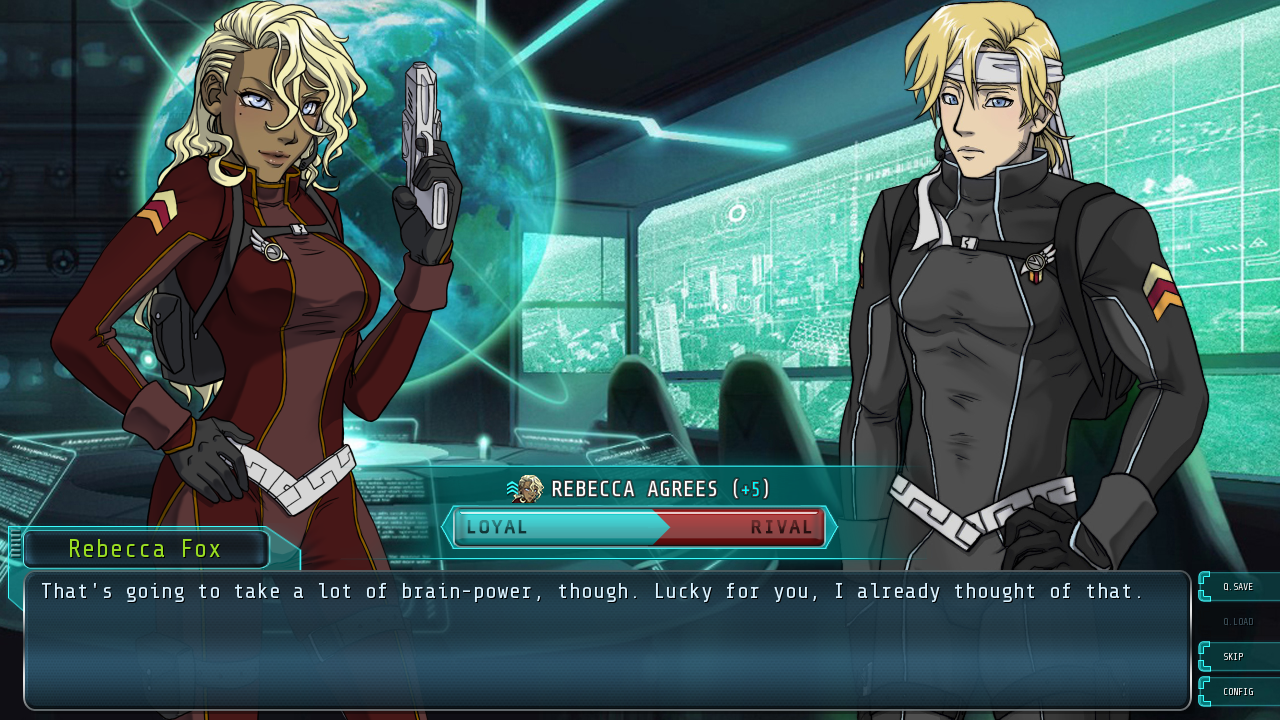

http://25.media.tumblr.com/ab2de23abd52b8bc3faf4b10dfa8ed96/tumblr_mpk1msKuV11qhts2bo1_1280.png" style="max-width:100%">
we're unsure if that will affect skills (probably not) but it could lead to different dialogues thorough the game (a bit like the Joking/Friendly/Forceful thing of Loren, but this time applied to each character) and have an impact in the romances. Currently not thinking that you must have a character Loyal to you to unlock his/her romance. It should probably be a separate thing, picking all the right answers.
Or maybe, it should be either max the loyal or the rival values? When you romance someone I believe you can't be "neutral" with him/her, you need to take a stance and impress him/her a way or another?
Lots of things to think about, but I like how it's going so far
Aleema
Jul 07, 2013
I wonder if I should change the phrase "Loyal" to "Ally" or something else? Maybe just "Friend"? I want it to be clear that being a "rival" doesn't mean that the character is prone to betray you or that it's altogether bad.
"Rival" should mean that the character disagrees with you often (you like aliens, they hate aliens) but they're technically loyal either way. They might scoff or roll their eyes at you rather than salute you, but they would still take a bullet for you. The reason we're taking this duel relationship system instead of the standard
+5 Relationship Points, must get to 100% or bad things happen! system is because most of these people you have already established your relationship with and starting over from zero would be unfair and unrealistic. Instead, the player is going to have chances to shape their existing (positive and loyal) relationship with the characters, watching how your relationship holds under stress. So there will definitely be flavor differences between the two types of relationships, which will probably be most evident in the end game and in romances. I think rival romances would be too interesting not to do.
jack1974
Jul 07, 2013
I think rival romances would be too interesting not to do.
I wholeheartedly agree

I think indeed maybe loyal/rival is not the best choice of words, but I am not sure what we could use instead... anyway probably will add some explanation/help in the game that will explain that getting 0% loyalty or 100% rival is NOT necessarily a bad thing!
jack1974
Jul 07, 2013
What....!

http://i.imgur.com/hQqZDfw.png" style="max-width:100%">
Jaeger
Jul 08, 2013
I think rival romances would be too interesting not to do.
I wholeheartedly agree
I think indeed maybe loyal/rival is not the best choice of words, but I am not sure what we could use instead... anyway probably will add some explanation/help in the game that will explain that getting 0% loyalty or 100% rival is NOT necessarily a bad thing!
Maybe something along the lines of Amicable/Disagreeable?
jack1974
Jul 08, 2013
Well yes seems good, however I'll leave the choice to native English speaker (like Aleema) since what makes sense for me might not be the best choice


