Mid-year update and switching genres

First of all a quick update: work on Thieves of Dingirra is going smoothly, at end of May I closed the late pledges since it wasn’t getting any new money anyway (I suspect something wasn’t even working correctly, who knows).
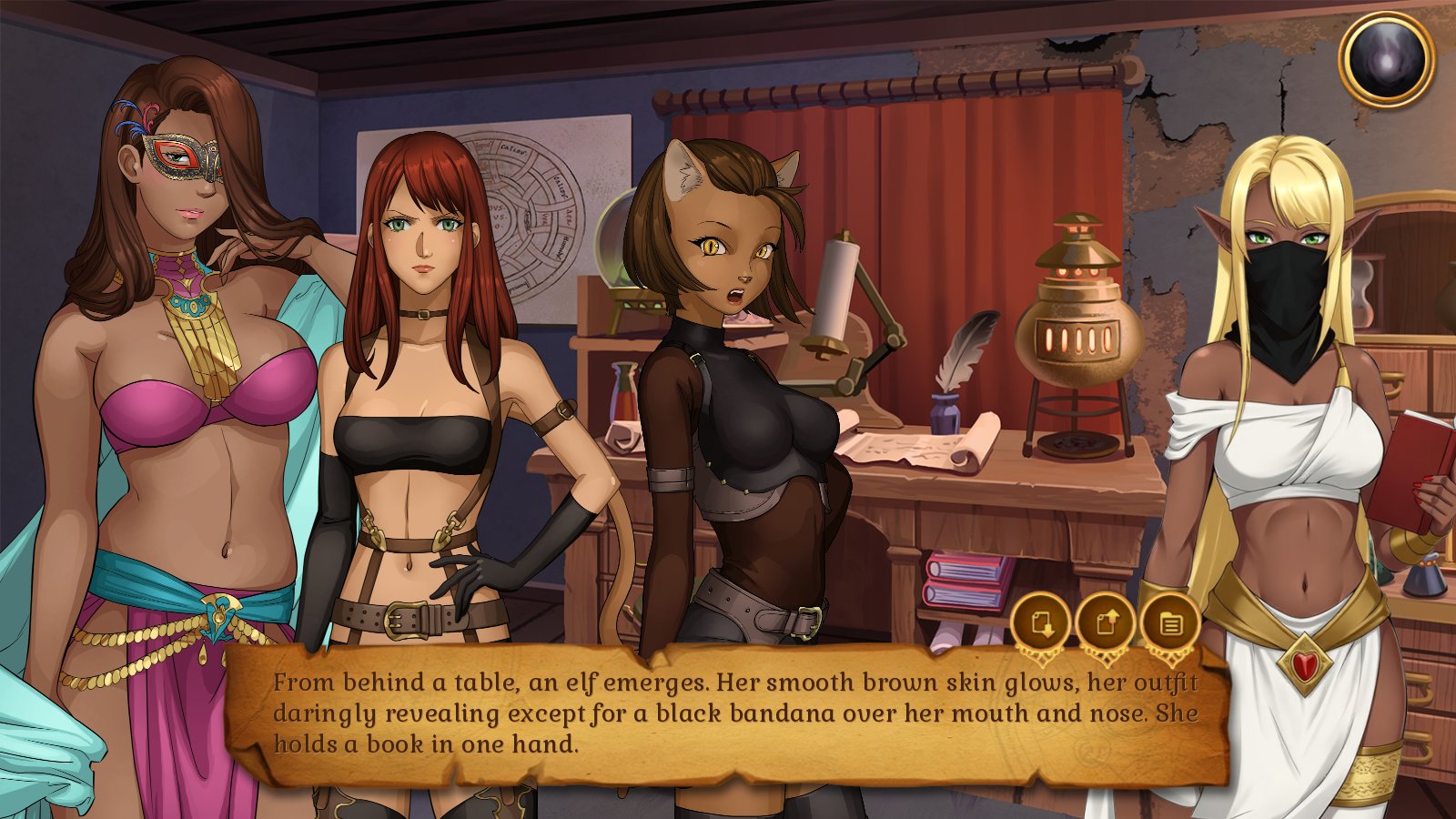
Next month I think will be able to post some juicy previews of the bonus outfits and sketches for a plus-sized female dark elf, who will be in a one-night stand available in the brothel (only the sprite, doing a CG would have been too expensive) that was funded by a backer!

I’ve also started planning the next Kickstarter featuring a male protagonist and several girls. More info in next months! So all is going well.

Switching genres?

Now back to the blog post’s title. Let me be clear: I like telling stories so I’ll always keep doing story-based games. Even if it has to be just a simple visual novel a year. However, it has become crystal clear to me that I might be forced by the market to switch mainly to another genre. Or perhaps if I’m lucky and hit the jackpot, do a single game in another genre, get a lot of cash, and then resume doing my usual games without any strict financial goals! haha

Let’s proceed in order, in my past blog post called “the death of visual novels” I already mentioned how bad the situation is for visual novels. I then did a research, comparing the amount of games on Steam with Visual Novel tag with some other genres, genres I know I could stand a chance if I decided to make a game in a different genre. I picked Card Game, because I already made two, Point’n’click adventure, I already made House of Chavez which was “first person”, but even having moving sprites on the screen wouldn’t be an issue in Ren’Py. City Builder because I could modify Thieves of Dingirra system to build stuff. Roguelike and Strategy are more broad genres but even in this case, games like Kingdom or other turn based genres are easily doable in Ren’Py (anything that isn’t real-time or bullet-hell can be done).

Here are the results (I did this search 3 months ago, they’re not up to date but the trend is clear):
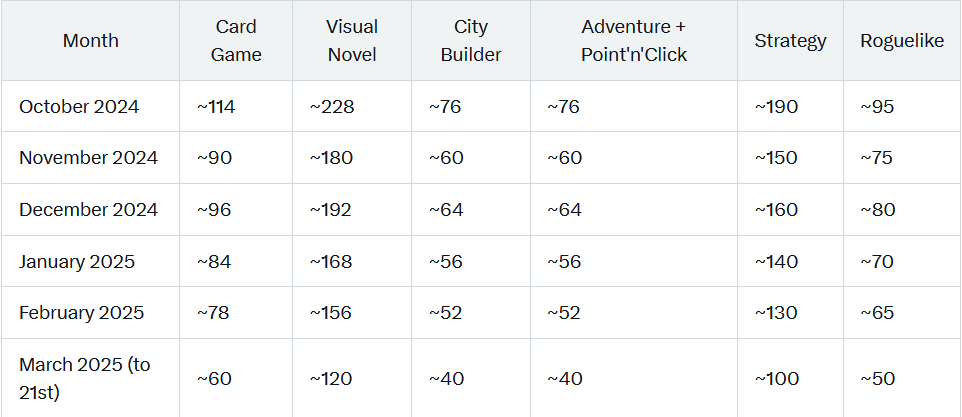
Lol, as you can see… Visual Novel is the most crowded genre, close to Strategy but as I said strategy is a bit too vague (it could include games like Civilization !). Anyway you get the idea.

Don’t get me wrong, Steam in general is super crowded now. Making not a hit, just decent money is very hard for most indies (unless they live in 3rd world countries with very low cost of living). But it’s obvious that some genres are more crowded than others.

What I’m planning to do?

Right now, nothing! I’ll finish the games I have in the works, including some unannounced games, but I might start doing some prototypes for fun on the side. This is nothing new, really, I have always done different genres, but always mixing them with visual novel. The main thing though, is that I really never made a “true” game for those genres, with all the requisites (or what people expect, I should say).

For example, Curse Of Mantras, has a very complex card collecting/battling gameplay. But having to mix it with the story, some people might not like to play it just because of that. It’s different if a genre has story as key element, like adventure games. But even there, I didn’t really follow “all the rules” – adventures usually are fully voiced. Even Thieves of Dingirra will have a mix between city management + RPG, but it also has a long story.
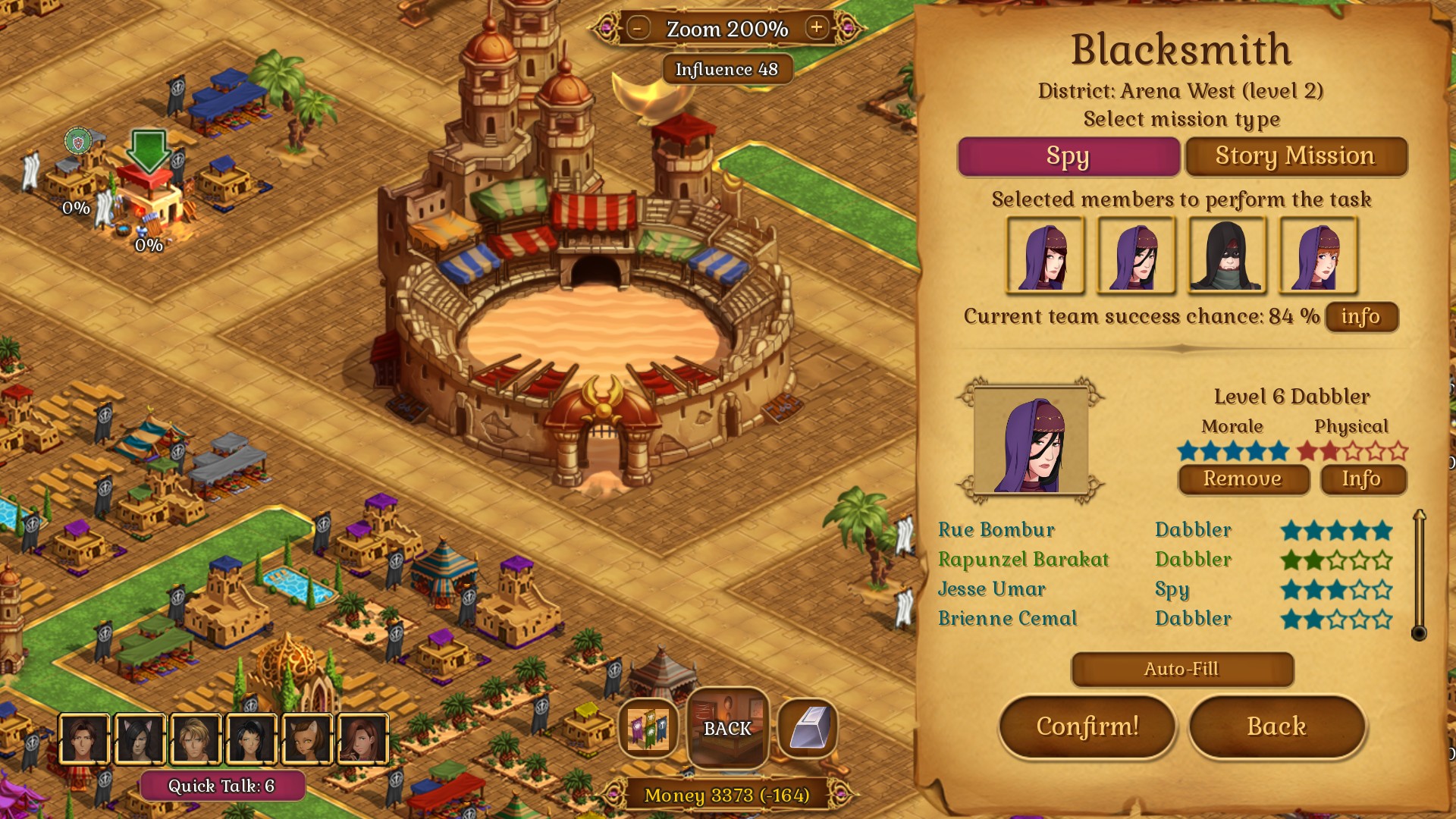
the mission auto-fill new feature at works. saved me a lot of time during testing!

Some people just want gameplay and not having to read. Or the gameplay itself needs to be different, like roguelikes. More punishing, focusing on meta-reward and all that.

Now I’m not a big fan of most other genres, but when comes to surviving the market, one has to adapt. After all until 2008 I was doing sports sims… and barely surviving. Then switching to VN first and then VN/RPG later, allowed me to be full time indie until now. So change is not always bad!

Anyway as I said in the beginning and I’ll repeat here, I plan to finish all the games in the works, and I’ll keep doing story-based games, unless the sales and the crowdfunding do so badly that I won’t even cover my starting costs, at that point it wouldn’t make much sense anymore as you can imagine!

So even if I start working on other genres it will be a slow process and I’ll always make smaller VNs on the side at minimum, simply because I like to tell stories (and some VN I made recently were worth it).

See you next month with some more juicy previews from Thieves of Dingirra!

Indie games and funding

Today, I’d like to dive into a topic that we game developers often debate in our private discussions, though it might not be something players are fully aware of.

Up until around 2016 (if memory serves), I was creating games without relying on crowdfunding. Then that year, I launched a Patreon, which provided support for my projects through 2020. That year was a turning point for me, not just because of everything else going on, but because I released what remains my most ambitious game to date: Planet Stronghold 2 (though Thieves of Dingirra is about to “dethrone” it!).

Lakadema was one of my favorite characters from Planet Stronghold 2

After the success of my 2018 RPG Cursed Lands, which left me feeling optimistic, I had high expectations for Planet Stronghold 2. I’m the kind of person who always braces for the worst-case scenario. For this game, I set my baseline at a very modest sales figure—less than a third of what Cursed Lands earned in its launch week. (Of course, long-term sales are harder to predict, so I was mainly focused on that first week and month.)

Little did I know that back in October 2018, Valve decided to roll out an “algorithm update” that effectively tanked visibility for anything that wasn’t a AAA title or an indie darling. Over the next three to four years, I watched about a third of the developers I knew either quit the industry or turn to publisher funding, sacrificing what I’d call their “true indie” spirit.

So when Planet Stronghold 2 launched, it was an absolute trainwreck. Even now, five years on, its sales don’t come close to touching Cursed Lands. The thing is, I eventually realized it wasn’t about the game’s quality—it was all down to Steam’s new rules.

Cursed Lands’ most popular characters were surely the two nagas, Sylrissa and Enok

This shift didn’t just change completely my business, it hit nearly every indie dev I knew. The only ones who dodged the fallout were those with an established fanbase or enough money to fund massive ad campaigns.

Here comes the money

Later in 2020, I decided to try crowdfunding for my first game in the Tales From The Under-Realm series, and it went really well. I might’ve mentioned this before, but I like to figure out my “virtual salary” by dividing the money a game makes by the months it took me to create it.

I’ll always have fond memories of Hazel, my first crowdfunded game

Well, Hazel’s virtual salary was about four or five times higher than Planet Stronghold 2’s! Mainly thanks to the fact that Kickstarter’s commission is only 10% vs 35% of Steam (they say 30% but with various fee and refunds it’s closer to 35%). Of course, it doesn’t always work out that way. Some projects, like House of Chavez, barely broke even, mostly because I wanted to make the game better and ended up spending extra cash from my own pocket.

That’s when it hit me: crowdfunding isn’t just nice to have; it’s a must to keep going. It doesn’t mean you’ll automatically succeed, but it helps you avoid losing money and lets you plan better.

Here’s why: if I know I’ve got a set budget for a game, I can figure out all the costs ahead of time. Then I can decide what’s really important to spend on and what I can skip if it’s not essential to the game.

Pre-production phase and conclusion

Unlike many indie developers, I don’t hold off on starting a game until all the funding is secured. Waiting for full funding can cause serious setbacks (think of all those Kickstarted games delayed by years!) and it’s tough to convince people to back you without something tangible to show. You can’t just pitch “I’m building a town sim with RPG combat and blah blah blah” without at least a working prototype or screenshots/gameplay videos to back it up.

making the map work decently was probably the biggest task of this game! took about 1 month!

That’s why I made sure Thieves of Dingirra had its core gameplay nailed down before launching its Kickstarter. It’s also why, even for a basic visual novel crowdfunding campaign, I aim to have a full plot outline, the main cast’s character art and a few CGs ready beforehand.

But then comes the tricky part: once the funding’s in, do I call it done, or do I spend an extra month or two—and more cash—adding new features or content? It’s a tough call, and honestly, there’s no universal answer. With House of Chavez, I went all in, pouring way more money into it than I raised because I wanted it to be the best it could be. Looking back, it wasn’t a smart financial move, but sometimes pride in your work outweighs the bottom line.

Conclusions

There’s a huge difference between blindly sinking a year (or more!) and a ton of money into a project like Planet Stronghold 2 with no guarantee of breaking even, and investing a couple extra months and a few grand to polish something you’ve already fully funded and you do it only because you want to make it the best possible. That’s the line I try to walk.

By the way, even if Thieves of Dingirra’s Kickstarter has ended, it’s still possible to do late pledges to add more one-night stand scenes to the Traveler’s Delight! Check it out.

Thieves of Dingirra Kickstarter!

First of all: the Kickstarter campaign is live since a few days and so far it’s the fastest funding campaign I’ve ever done! Currently heading to the second stretch goal, adding the elf race. Check it out: https://www.kickstarter.com/projects/winterwolves/thieves-of-dingirra

As you know, I decided to make this game a blend of RPG combat and town management. It’s funny because, just last year around this time, I was putting the game on hold, feeling completely burned out by its complexity.

Fast forward a year, and here I am! But, of course, I’ve made progress. The map gameplay is in a great shape now. While there are still some details to tweak, I finally feel confident that it works. That’s a big deal because, at the start of this year, I still wasn’t sure if the map system would work in Ren’Py—whether it would run smoothly, whether I could make it fun, whether… well, there were a lot of “ifs”!

The map gameplay

So, how will the town sim work? I’m aiming for something simple to learn but with enough depth to provide a long-term challenge. For starters, you won’t be able to build new structures in the town. I made this choice to keep things from becoming overly complex. Allowing players to destroy and rebuild buildings would have introduced an extra layer of complexity, both in design and in balancing the gameplay. However, I am planning to let player upgrade merchants and houses to increase the money / influence you get:

This is all due to the balancing of the gameplay. I already had to run several tests using developer cheatcodes, to make sure that once you owned half the city and had 100 guild members stats wouldn’t get completely messed up. Good news, seems it’s working fine (but the beta will tell for sure). You might ask what is the goal of the game then, if you can’t build things like in most city builders.

In practice, your goal will be to rob and acquire all the town structures, one by one, district by district. The town is split in several districts, each one belonging to one of the four families, a neutral zone (where you start).

You’ll have a roster of member in your guild, and you can assign each member to a specific task. There’ll be scouts that can acquire information about potential targets (that’s the first step). Then, each target will require a different approach. Sometimes, you’ll need to rob a wealthy merchant. Other times, you’ll need to assassinate a powerful enemy, and so on. Each different job will require a different specialization, indeed in your guild you’ll have a variety of recruits, each one more suitable to a specific task.

The NPCs will also trigger regularly some random events, based on the traits they have. In the example above, since that NPC has the Greedy trait, will ask for a salary raise more often. On each random event you’ll have different choices available which will result in different outcomes. This should add a good replayability!

The RPG gameplay

So, how will the RPG mechanics fit in? Simply put, you’ll need to personally fight a set number of battles for each district. Think of them as “story missions” that can’t be delegated to your guild members. This approach ensures a fixed number of fights with no grinding required—a feature many players disliked in some of my previous RPG games.

Throughout the missions, you’ll encounter a map that many will identify as a classic roguelike layout, featuring multiple “nodes” that lead to a final boss room, your main objective. Each room offers randomized content and outcomes, determined by your stats or decisions, enhancing replayability significantly!

As for the main character, the Master Thief, you’ll have two base classes to choose from: Shadow Thief and Reaper, each offering a unique set of skills. On top of that, there will be a Talent system, similar to what I implemented in Cursed Lands, but tailored specifically for thieves.

Lastly, I decided to go with a first-person view for combat. This means there won’t be a front/back row mechanic, which simplifies the RPG gameplay and provides a stronger visual impact.

The romances

Naturally, the game includes a storyline with romantic love interests. I believe I’ve mentioned this before, but to recap: the dialogue will vary depending on your attitude toward each character (you can be assertive with one and kind to another), and each character has a relationship value with the others. Your decisions will influence these relationships, unlocking additional unique scenes. Sounds complex? It is, but don’t worry, a “relationships screen” will provide a clear summary of everything.

Conclusions

I hope this post has sparked your interest in what I consider the biggest project I’ve ever taken on—or, more accurately, attempted to make, since it’s not finished yet! I know it sounds ambitious, especially considering how many times in the past I’ve told myself I was done with big games—particularly after tackling massive projects like Planet Stronghold 2.

But this year felt like an all-or-nothing moment. If you read my previous blog posts, you’ll know that earning a living solely from pure visual novels has become increasingly difficult. Saying the market is oversaturated would be putting it lightly! So, I decided to take the plunge.

That said, I do have another simpler game (not a 100% VN though) I’d like to start this year, which I hope will keep things balanced. Once I wrap up Thieves of Dingirra, I’m really looking forward to some well-earned relaxation!

Christine’s Care release and what’s next

If you’ve followed me on socials, you know that my new yuri visual novel Christine’s Care is going to be released this month on Steam (game is already out on itchio).

Liz is ready for the gay parade!

I’m curious to see how the game’s reception will be, since it’s rather different from my usual visual novels. It has a different art-style, a slice of life setting, a general more “serious” tone even if in the game there are many fun moments, and so on.

The Kickstarter didn’t do particularly well, however as I said in the past, even a game like At Your Feet had an average Kickstarter but then it sold extremely well on Steam (though it’s probably due to an untapped niche).

one of the first images I commissioned for this game, still one of my favorite

To be honest as I was writing this game (I had already a base plot done by another writer, on top of which I expanded it) I really started to get attached to each of the characters, indeed the final story turned out much longer than I expected for a $9.99 game. It’s longer than many other games I’ve done. I wish I could have added much more art, a full Donna storyline, and so on. But as always, it’s people who decide what gets done and what doesn’t, and once again I’m in red even with this game haha (meaning that I spent a bit more than the KS funds + Patreon money to make it).

Anyway: if you play this game and you like it, or in general if you want to see more games like this from me, buy it or if you can’t (I understand – times are tough) even spreading the word can really help!

What’s next… the biggest game I’ve ever made!

work in progress, almost done with core gameplay loop

So after Christine’s Care, I’ll do the crowdfunding for Thieves of Dingirra, the biggest game I’ve ever tried to make! A combination of city management + RPG + visual novel is something I didn’t think I would ever try to do, but here I am.

I spent the first months of this year doing more tests and refining the core gameplay loop – something I had to do even before thinking to start writing the story. I am at good point, but I’ll give more details on next month’s blog post.

this is how the missions play out. Lots of replayability!

I have also finished all pre-production for another project that will see the light after Thieves of Dingirra, the one with the male protagonist. It will be a very fanservice game, very crazy/comedic and with a simple gameplay beside the story that I think should make it rather fun. Once again more details when we’re close to the crowdfunding, hopefully this Summer.

That’s all for now, stay tuned for next month where I’ll give you all the details on Thieves of Dingirra! The crowdfunding might start towards end of this month or early April.

The death of visual novels

What a charming title for a blog post, uh? haha

Well, sadly, I think this year could be the year. Let me explain what I mean by this. I mean the death of visual novels as a viable indie developer genre, not the death of visual novels as genre!

Rather the opposite, indeed. Last year I asked my old friend Ichiro about some Steam visual novel stats and this was the result:

Yes you read it right, in August and November 2024 there were 199 new VNs released in a month. In December, 156. In January 2025, 186.

That means that players see roughly 7 new VNs a day on Steam. A day! Imagine opening Netflix and every day there are 7 new shows to watch. You wouldn’t even have time to do check the trailers !

So, for players it’s a very good moment, but for developers? It’s super tough, of course.

What is the reason?

That’s the next question of course. Well, VNs are probably the easiest kind of game to make. So that’s the start. But recently, there’s another element which is making the overall development even easier: the advent of AI, and Steam accepting AI in games.

Until early 2024 (I think, I don’t remember exactly) Steam had a strict anti-AI policy, but then they allowed it, providing devs disclosed any use of it. And guess what? A lot of devs started using it. I know many players are against AI, but apparently the majority isn’t (also maybe in the adult games category, people really don’t care much lol).

So while before anyone could make a game, but they still had to pay character artists, background art, music, and even a writer if they didn’t know how to write, now they can do all those things with AI, saving a lot of money.

Because let’s be honest – the first thing that catches interest in a game like a visual novel is the art. You can write the best story ever, but if there isn’t nice art, most people aren’t going to buy and play your game.

Personally, I find AI generated art all soulless and even ugly / unrealistic. But this is my personal opinion. Let’s go on with the reasoning.

But wait, things can get worse!

A consequence of this influx of games is the likely onset of a price war—and to some extent, it’s already begun. This could play out in one of two ways:

  1. Lower Prices: Games that would typically sell for $15–$20 may now be priced at $5–$10 to remain competitive.
  2. Overloaded Content: Developers might keep the original price tag but pack their games with massive amounts of content—such as 8–12 love interests, 100 CGs, animations, full voice acting, and more—to justify the cost and attract players.

So, once again, for players it’s only good news – more bang for their bucks! But for devs ? Uhh, things aren’t going to be great!

For established devs like me who have a following, things are already tough (I barely broke even with my last 2-3 games) but for starting indies? I honestly I wouldn’t want to be an aspiring visual novel dev right now.

I know this whole post might seem depressing, but I swear I’m only trying to warn people about the current state of the market, nothing more, nothing less. Then of course, there are still chances to make money, but it’s important to keep expectations low, very low.

In a way the VN market is becoming similar to the books market – where the 1% earns 99% of the money, and most of people fail to make a living with it. So, nothing new, really.

What am I planning to do?

I plan to keep working on the current projects of course, and in particular Thieves of Dingirra and games that have more complex gameplay added to the visual novel genre. I think in future might be even more important, to add extra gameplay to differentiate your game from the huge crowd of VNs.

However, I don’t want to hide that at the end of this year I’ll need to review a bit the results and then I might be forced to make a choice – simply stop making simple visual novels (which would be a pity since sometimes I like to just write a story without having to design gameplay or code), or maybe be very careful when planning the budgets.

Another thing is that in the past in several games I overspent, using all crowdfunded+patreon money and adding funds from my own pocket because I wanted the game to turn out the best possible, but sadly it had no noticeable impact on the sales.

As you can imagine, raising funds to use them all to pay artists and then earn less than a minimum salary isn’t a sustainable long term strategy! Also, in the last 3-4 years felt like that my games’ success was all a bit random, and depending ONLY on the game idea/setting, art, kink and so on. Like if all the work behind it meant nothing. Totally based on the Steam “algorithm”. Ugh.

This is what surprised me mostly! It was like “you need to chunk out cheap games as quickly as possible, hoping to hit a jackpot, and nothing else matters”. You add a theme song? no impact. You spend $2k on beautiful hand drawn backgrounds? no impact. You spend lot of time writing interesting dialogues? sure, lots of praise in the reviews, but for sales? no impact. And so on. It’s… a bit depressing, really!

Conclusions

One last thing: this is not something exclusive to visual novels, there’s a sort of global crisis of game development companies all around the world. I think though, for the reasons above, that VN is one of the genres that are suffering mostly from this. On Steam you’d have better chances of making money doing a roguelike, strategy, survival, sim, etc, the less crowded genres.

Anyway, let’s see what happens first, since I have high hopes for the games I plan to finish this year! Also, a friend doing adult games commented on my games saying that the main issue is not having a male protagonist (which apparently is very important considering the Steam target market), so who knows maybe that will change things in the next months! Thieves of Dingirra will have all the romance combos, and the unannounced game will be boy x girl exclusively.

Speaking of Christine’s Care, I am planning the beta later this month, since all the art is basically done, and the final release sometimes in March! So if you haven’t yet please wishlist the game on Steam.

Sorry if the post sounds too negative. I’m honestly not too worried for myself, I’ve been indie since over 20 years and I’m confident I can always find a solution. But I think young devs approaching the VN world needs to know the challenges that they’re going to face! And if you’re one, good luck !