Category Archives: marketing tips

BecauseWeMay sale and game prices

First of all I wanted to inform you that I’m participating to the BecauseWeMay initiative. What is it? Quoting from the website:

We believe that developers should have the freedom to price their games how they like, without interference from the online stores that sell the games. Why? Because it allows us to promote our games more freely, as we are doing here! We rely on the ability to promote our games for our livelihood and control over pricing is an important tool for this purpose.

For the last week of May (May 24 through June 1) our games will be deeply discounted to celebrate online stores that give us control over pricing: The App Store, Google Play, Steam, Desura, IndieVania, and a few others.

I offered my game Spirited Heart + Girl’s Love at half price, sold directly and in the Google Play store.

About game pricing

Game pricing is more complex than what people imagine. I often got comments about how my game prices are too high, and I should price them $9.99, because that’s what an indie game should cost πŸ™‚

You can talk about what indie is, what is really worth (3d cutscenes or GAMEPLAY?) and if my games sucks or not. But one thing you simply cannot argue are the statistics. Us developer aren’t setting the games prices randomly! At least, I don’t. If you’re an indie dev you should only listen to your statistics and not what people tell you. Doing occasional sales like this one is fine of course πŸ™‚

Also, this is my personal experience. I am sure different game types have different audience and prices. I cannot imagine a tower defense or a platform game to cost more than $9.99 for example!

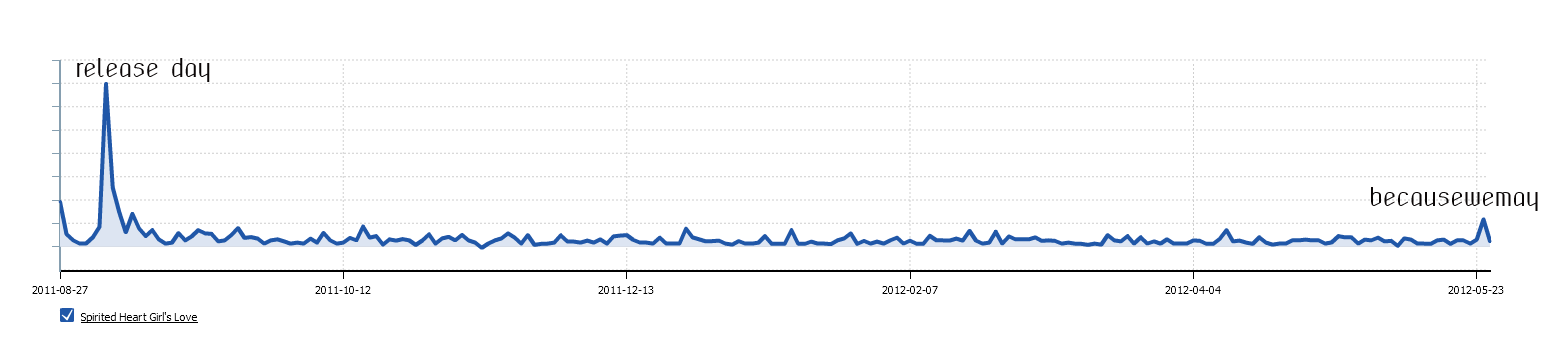
Now, let’s see some graphs just to explain better. Below is Spirited Heart Girl’s Love revenues graph from the launch day to the BecauseWeMay sale:
Shgl

…not an impressive bump eh? The fact is that during the release day, all sales came from my own site only and a few affiliates. Instead I got lots of traffic from because we may initiative, but despite having many sales, the half-price really hurts revenues. Still, was a somewhat good result compared to the regular sales. Maybe I should lower game prices then? Let’s check Spirited Heart graph instead:
Sh
…for this one I didn’t even had to go back to the release day to find more profitable days. In two previous occasions, when I sent the newsletter to announce updates about Loren or promote some other game, I got more revenues than for the BecauseWeMay sale. And I got much more traffic from the becausewemay initiative than during those newsletters!

And portals?

But what about portals ? Sadly as you know my experience is very limited, but luckily there are some very indie-friendly portals like Desura. I don’t have Spirited Heart there (couldn’t make it in time since uses DLC and I don’t know yet how to implement it) but I recently put Planet Stronghold, and many people complained about price. So, after a while I did a sale last weekend for $9.99 instead of $24.99, and I promoted it on twitter, and showed up on the “on sale” section of Desura (which I think is the most visited! lol). Result:
Desuraps
Yes, the day of the sale the revenue was slightly higher than release day, and in other two occasions. But what about in the long run ? I am not really sure, considering the increase was so small that could have just been a random thing! Also, I should compare prices without a promotion, because is normal to have higher exposure during a promotional sale…

I will continue to experiment with prices of course, but so far everything seems to confirm that lower prices = lower revenues. I’d be very happy if I could make same amount of money (or maybe more) and at same time make more customers happy, but so far it really doesn’t seem the case.

Friday catblogging – Merry Christmas!

In the picture above, Mirtillo and Othello sleeping together peacefully. I wonder what they’re dreaming ?

I want to wish everyone reading this blog/following me Merry Christmas! πŸ™‚

Then, a quick status update about Planet Stronghold 0.8 (since is the game I’m currently working on). In the recent weeks had some eyesight problems, so the programming has been slowed considerably. I really hoped to have it ready by Christmas since would have made a great present… but sometimes, real-life problems get in the way and so I had to post-pone the deadline to end of the year!

I’m writing the latest two quest, regarding the Apex Rahn and Arnox races, including two boss fights. I think once you play the game you’ll realize why is taking me so long to make… because the game IS long! The part I’m writing now involves all the races, and if you side with the Empire you have to eliminate them, instead if you side with the King/Shiler you will unify them and form one single alliance.

So this part is the “core” of the game, the biggest one. If you played the demo, this part is basically 5-6 times longer than it…and you can play from two different sides, so some parts are different! That is also why the final release price will be $24.95 (so you have still one week to get it at the deal price of $9.95!). And now, for some postmortem-retrospective about the year that is about to end:

2010, The Year Of The Tiger

I admit I was excited about it (since I am a Wood Tiger in chinese horoscope). Well, my goal for 2010 was to release 5 games, and I was particularly excited about (quoting from my last year post):

And I am producing the art now for a new kind of game style that I hope will be a great success, since I like a lot writing the stories and the storyboards for it. For now I can only say that involves detectives, mystery, and a beautiful blonde girl with a French accent…

I was obviously talking about Vera Blanc, which as you might know, turned out to be a real disappointment in term of sales πŸ˜€

So, in 2010 I released The Flower Shop, Card Sweethearts, Vera Blanc: Full Moon, Vera Blanc: Ghost In The Castle. Not only I didn’t release 5 games as I had planned (even if I’m almost done with Planet Stronghold), but most of them didn’t sell well at all! So in all honesty, considering also the other real-life problems I had, 2010 was probably my worst year since I was indie. For the first time in 7 years or so, I didn’t grow my business. During the summer and autumn, I thought it was something beyond my control, the global crisis, the return of middlemen and so on (since also many other indies had very low sales during that period) but if I think about it carefully, it was my mistake for producing games without doing proper “market research”.

Vera Blanc got the most positive reviews I had for a game, on famous sites like Gamezebo & Gamertell. And it has some fans that are eagerly waiting a 3rd episode. Still, it would be foolish for me to release another one using the same gameplay system… so even as indie, you can’t simply do any game you want to do (unless it’s an hobby) but you must also identify the market you want to sell to, and make sure you have the right product. Making a good/original game just isn’t enough, if that game has a very small fan-base.

Next friday, more cats pictures and my plan for the 2011 which hopefully will be a better year πŸ™‚

Which kind of games sell more?

That’s a question that many game developer ask or just wonder about. I just realized that through the course of years I made games of very different genres, so I checked some stats and came up with the following “ranking” which I hope will be useful to someone:

  1. RPG (roleplaying) games (included my games Magic Stones, Spirited Heart and hopefully will include also my upcoming Planet Stronghold)
  2. Dating Sims – (included my games Summer Session and Flower Shop)
  3. Sports Simulations – (included my games The Goalkeeper, Universal Soccer Manager 2 and Universal Boxing Manager)
  4. Visual Novels – (included my games Heileen 1 & 2 , College Romance and Bionic Heart)
  5. Strategy/Simulations – (included my games TV Station Manager and Supernova 2: Spacewar)

those represents total sales though, and are somewhat misleading because there are other factors to consider. First, in the visual novel category there are 4 games but the sales difference vs the strategy/simulation isn’t so big, so each individual game on average sold less than the strategy/simulation ones. Second, I should also consider ROI for each game. How much time I spent vs the revenue obtained for each game? I never calculated it exactly but I can fairly accurately say that the first titles (sports simulation) were the best ROI for me (took me 3-4 months each). But it could be so only because they’re also the oldest titles πŸ™‚

Anyway, that’s more a fun statistic than anything to be taken too much seriously, but even talking with other programmers, it seems clearly that RPGs are the best selling genre for indie games. Probably because there aren’t many around (if you exclude RPGMaker ones, otherwise there are a LOT! :D)

Dating sims share also many elements with RPG (statistics, dialogues, relationships, etc), while sports simulations are very hard to make, but can provide good revenues if they’re original enough. Visual novels can be profitable if made quickly and without spending too much on assets, and strategy/simulation last place is really to be taken with a grain of salt: after speaking with many devs who shared revenues with me privately, if you do a good 3d strategy game this genre can easily beat all others, on par with RPGs.

How to be an indie and retain your sanity

This is somewhat of a funny post, but there’s truth in it, I assure you πŸ™‚
What I’m talking about? I’m talking about how not to lose motivation or get “burned”. Getting burned is really more common than what you might think. If you consider that most indie spend months (if not years!) on the same game, is easy to understand that you can be burned.
By burned I mean that you can’t really stand anymore in front of your monitor coding your awesome game XYZ. Usually the indie game development is divided into 3 phases:

  1. game concept / design – this is the most funny part for sure. You start writing down all the possible amazing/awesome features that your game is going to have. Is easy to get things out of hand during this stage. Already at next stage you can be sure that you’ll read some of those features and think “I was nuts? How I could really think to have a full 3d walkable world??”
  2. implementation – this starts great, but as the time goes on, in 99% of cases become like any other “real job”. Bugs shows up, testers complains, you realize that what you thought would be aΒ  great gameplay system actually sucks. Then, what you do? You necessarily have to rethink some parts completely, so you rewrite them and then start testing again, and so on. In this stage you also realize how “this quick 2 months project” will turn into a “long 9 months project” easily.
  3. polishing/release – polishing is really an IMPORTANT stage but so many people (including myself) don’t take it into much consideration. How some small little insignificant features are going to change the game sales so much? is not possible! No, you’re wrong, it is very possible πŸ™‚ Then there’s release day and unless your game sells within a few hours you’ll start having some serious crisis.

Some people get so pissed during stage 2 or 3, that they put project on hiatus, or even abandon it completely. It might seem strange but this happened to me too in the past, with two games. One was a fantasy RPG which I was coding (I realized that was insane to do all the coding myself!) and another was a mission based shoot’em up (I realized that it was such a poor selling genre that I would have wasted my time).

There are some solutions though that can help indies to finish their project and avoid burning. Some are rather obvious, others less:

  1. take breaks from PC. Seriously, go out, take a walk, take a break of a few days, go on holiday, anything – if you’re burned, and if you’re late but insist on working you’re most likely to be burned even more and lose days doing nothing but getting stressed. Even only a small break can let you regain motivation and reduce stress.
  2. have a small side-project. This has really worked well for me. For example now I’m doing Planet Stronghold but at same time several other “minor” games. This helps me because if one day I’m too tired to code complex RPG mechanics, I can always “relax” by going on with some much simpler gameplay elements.
  3. do other tasks. When making a game there are LOT of other task beside programming it. Things that are usually easy and don’t take much time/resources. You have done the website of the game? did you setup the product in your vendor control panel? did you wrote the PR (press release)? have you blogged about it? did you contact some journalists to ask for interview/previews of the game? the list is long…
  4. outsource/find a partner. This is really useful if you’re like me, and even if you can code yourself you’re too tired to do it now. Beside, if you outsource to the right person, you’ll get a better overall result. In the beginning I was doing *everything* myself: coding, art (using poser), gamedesign… But now I have started outsourcing art already since 2 years, and next year I’m probably going to outsource coding as well, because what I do better is gamedesign. If you’re a coder, is stupid to save a few thousands and try to do yourself the art. And viceversa if you’re an artist, is stupid to waste lot of time trying to understand how to code (even with some easy tools) when you can outsource or partner with someone else.
  5. better have a smaller game finished than a big game never finished. Some indies attempt making something too big. Cut features out , as long as the main gameplay stays intact. If the smaller game works out, you can always make a sequel with all the features you cut out and the game will sell more. Some examples of this are Positech Kudos 1-2 and Democracy 1-2. Each sequel adds much more to the original game and I’m sure they sold more. So, build a smaller game to “test the waters” and if works, work on something bigger.

Why you shouldn’t compare adventures with other kind of games

Was talking by email with Dave Gilbert of WadjetEyeGames yesterday about some complaints from players for the length of story-based games like adventures or visual novels. Some would say that for $20 they expected at leat 8-10h of “gameplay”, since most other games you find (especially in portals) offers you that.

As I wrote already a few weeks ago in my “how long is it” post, you can’t really compare such kind of games with other games. Take a look at the Hidden Object Games you see in portals: they offer usually 4-5h of gameplay, but they do that using several tricks:

  • first of all, there’s much less text/narration. This isn’t necessarily bad: many people don’t like to read much texts, and that’s why I want also to make some more classic adventure games alongside my actual Visual Novel and Dating Sims. But is much easier to write a story with less dialogues, than come up with a long story rich of plot twists and interesting situations, as you can imagine
  • then they’re filled by minigames. Many minigames are mini-puzzles, so it depends also how skilled you are. But should that count towards the gameplay length? If so, the problem then is not the actual story/plot length but the kind of minigames that are in it. Also the risk is of breaking the narration by putting too many minigames, so there will always be someone unhappy
  • reusing content. Many games reuse locations, for example the same background, but you have to find different set of objects. That’s ok of course, as a game designer I know perfectly that you often have to find a compromise. But is the player really happy about that? I mean, why stretch the story/gameplay recycling stuff, just to “reach 5h of gameplay”?

I understand the complaint of some people, but you need also to understand the amount of work that’s behind those games. Is much easier to come up with a new “reskin” of time management games or even strategy games (unless you put something different). Many RPG made with RPGMaker XP uses all the same tilesets/sprites! So you need to understand how hard is to make adventures, since you can’t recycle/reuse stuff, but everything needs to be drawn from scratch, a interesting story needs to be written, and so on. There is a reason if mainstream AAA companies left adventure games a few years ago. Now they’re coming back a bit because with 3d content is indeed possible to re-use many assets (a new character can be easily created starting from a old 3d model as base).

I really think that the only solution in this case would be recurring to microtransactions but also some online game. If I was selling my Vera Blanc games for $9.99 I probably would sell more copies but would almost for sure make less money overall (believe me I tried so many times to lower prices but I simply couldn’t survive with the revenues).

So I was thinking that a webgame made like an adventure, at a very accessible price (price based on game length) should make everyone happy and at same time being online could get more viral and known, so get more exposure (needed because if I set such low pricetag I need to shift much more copies).

Though I’m sure there still would be someone who complains about price πŸ˜€